Robotic Process Automation (RPA) is no longer just a "pilot project" – more and more domestic companies are building automation strategies around robots in a scalable, business-viable way.
Where is the RPA market heading in 2025?
According to Gartner, the global RPA software market grew by 22.1% in 2023, reaching USD 3.2 billion. This growth outpaces the 13.2% growth of the application infrastructure and middleware market, as well as the 11.1% growth of the overall software market. /Source: https://www.gartner.com/en/documents/5614191?utm /
According to a report by Grand View Research, the European RPA market is projected to grow by 37.5% between 2025 and 2030. Based on regional trends, the domestic market could also show significant growth (analysts estimate it to be between 15–20% for 2025–2026). /Source:https://www.grandviewresearch.com/horizon/outlook/robotic-process-automation-market/europe?utm_source /
Specific data regarding the Hungarian market is limited. Based on vendor data, the estimated value of the Hungarian RPA license market ranges between 2–3 billion HUF per year, with the associated consulting services amounting to 4 billion HUF per year.
Among domestic companies, the financial sector is primarily leading the way, with almost every bank and insurance company being a major RPA user. They are closely followed by utilities, telecommunications, and retail.
The domestic market is dominated by platform vendors such as UiPath, Automation Anywhere, and SS&C Blue Prism. These products are also listed as international leaders in Gartner's 2024 Magic Quadrant report.
As good as the rise of process automation and the dynamic evolution of technology sound, companies that have already introduced robotic automation often face serious maturity and strategic challenges.
What are these challenges?
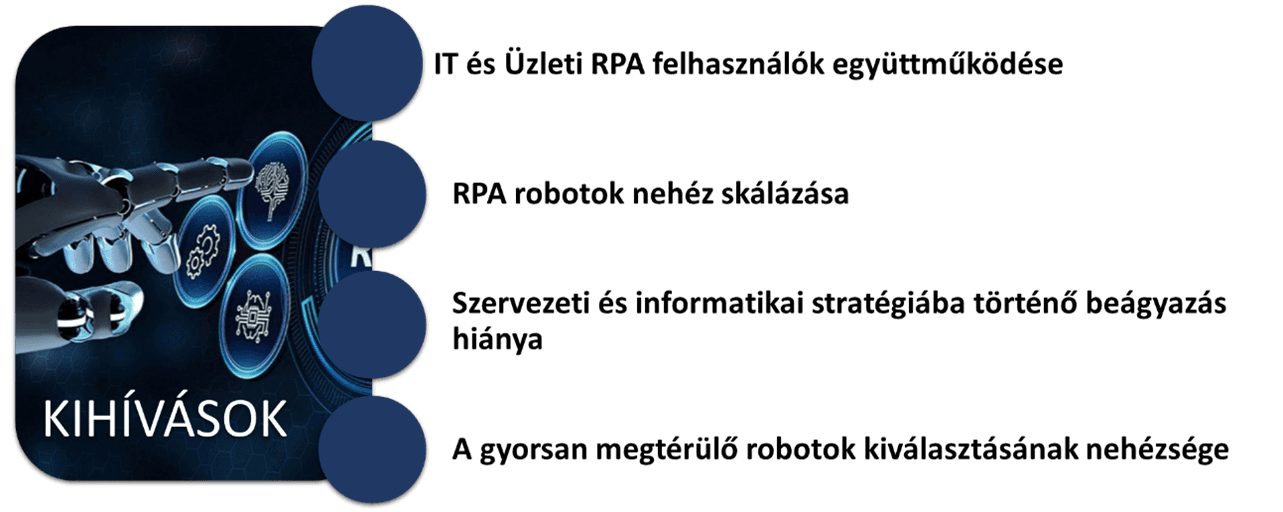
Collaboration between IT and Business RPA users: The business side knows the processes but does not always possess the tools or competencies required for automation. In contrast, the IT department is often overburdened and cannot always react quickly to business needs. A coordinated division of tasks and planned competency development between the two areas are key to the sustainability of automation.
Difficulty in scaling RPA robots: Implementing 5-10 robots can work in an "ad hoc" manner, but if an organization wants to automate dozens or hundreds of processes, infrastructural, robot management (resource shortages, monitoring), and sensitivity issues (UI changes, system updates) may arise.
Lack of integration into organizational and IT strategies: Many organizations start automation without a long-term strategy or roadmap behind it. Initiatives remain isolated (typically projects of the business unit) and do not connect with enterprise digitization efforts.
Difficulty in selecting quick-win, high-ROI robots: Projects often do not focus on the processes with the best return on investment or the easiest to automate; selection is based on personal intuition or "internal pressure," or a proper analytical methodology is missing. In the absence of this, automation can stall and lose credibility at the leadership level.

In this case, RPA can indeed deliver a significant return on investment in automating corporate processes in a fast-to-implement, sustainable, compliant, and scalable manner.
Exciting trends in the next 1–2 years – where is process automation heading?
The coming years open up new opportunities for RPA user organizations and service providers:
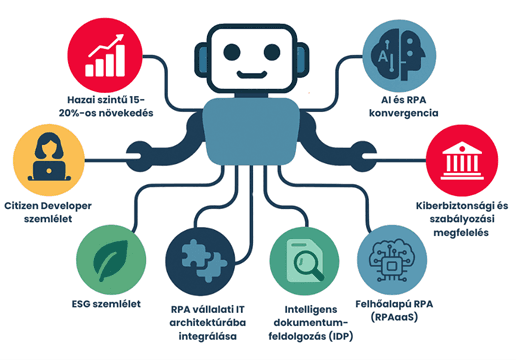
At the domestic level, a growth of 15–20% per year is expected between 2025 and 2026, primarily driven by opening up towards the mid-market sector and public administration.
RPA Lifecycle Management – increasing emphasis is being placed on integrating RPA tools into the enterprise IT architecture, proper maintenance, and cost-effective license management.
Citizen Developer Approach – Low-code or no-code, increasingly user-friendly and easy-to-use RPA development platforms allow non-technical users to create, maintain, and monitor automation solutions, which accelerates RPA adoption and increases business agility.
Cybersecurity and Regulatory Compliance – the continuous tightening of the regulatory environment (NIS2 and DORA regulations) and organizations' increasingly strict IT security requirements demand that RPA systems be placed under more rigorous monitoring.
The Convergence of AI and RPA Technologies – Intelligent Process Automation opens new horizons towards broader automation of end-to-end processes – meaning robots are not necessarily stopped by a human user, but supplemented with AI solutions, they will be capable of performing complex tasks previously done by humans, such as document processing and speech recognition. The merger of RPA and Machine Learning is also manifested in most platform providers working to enable robot development via AI solutions within 1–2 years.
Intelligent Document Processing (IDP) – RPA systems increasingly integrate intelligent document processing, which enables automated data extraction, analysis, and classification from unstructured sources as well. This significantly expands the scope of RPA usability in corporate processes.
ESG Focus – more and more corporate processes are shaped by paperless and energy-efficient operations, where automation unquestionably supports sustainability.
Cloud-based RPA (RPAaaS) – The spread of cloud-based or hybrid RPA solutions allows companies to implement automation solutions faster, more cost-effectively, and flexibly than ever before, reducing infrastructure costs. According to a Deloitte survey, 64% of organizations achieved cost savings by moving RPA to the cloud.
How can Clarity Consulting help?
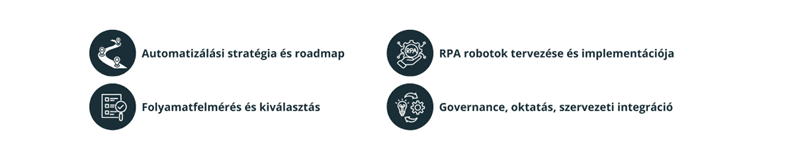
Our mission is to work together with our clients to design a process automation strategy and technological solution aligned with their digital maturity, which contributes to more successful and efficient operations even in the short term.
We do not just hand over a tool to companies; we accompany them from strategic planning through technical implementation to scaling.
Clarity possesses:
20+ years of experience in understanding organizational digitization needs in large corporate and public administration organizations;
multi-platform automation experience;
deep BPM knowledge based on international standards, with experienced BPM experts;
experience in connecting automation and other technologies (AI, workflow systems);
Clarity Digitization training for clients.
If you are interested in how RPA can become the key to your competitive advantage, contact our experts!
tel.: +36 1 422-3030 | fax: +36 1 422-3032
email: info@clarity.hu