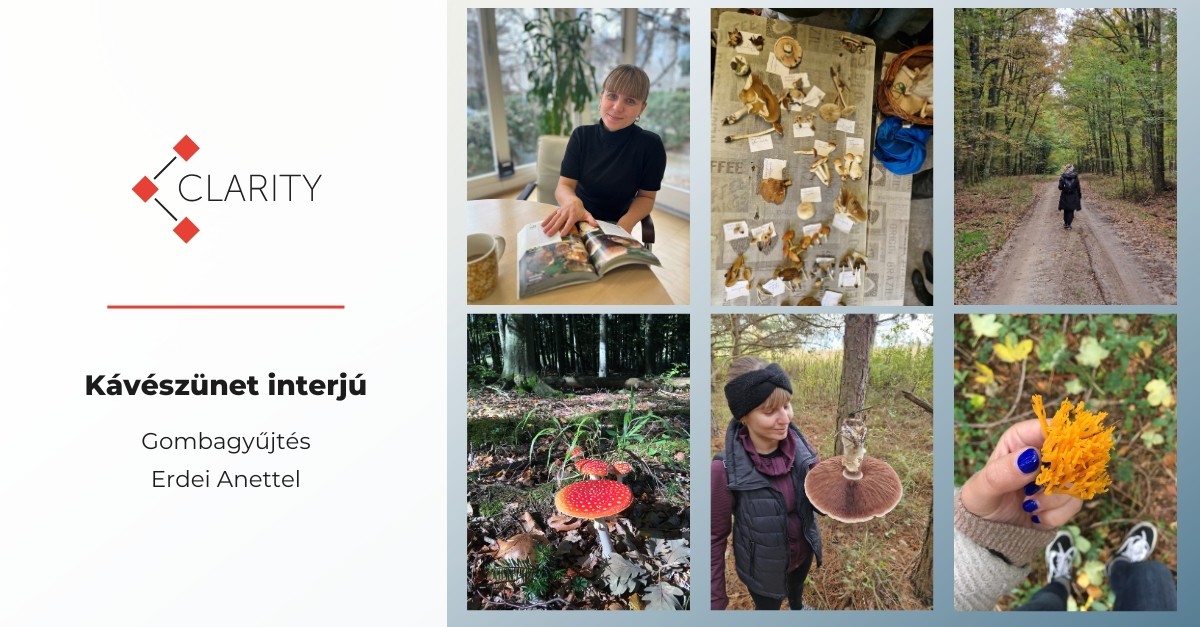
Clarity We held our first Coffee Break interview of this year with Anett Erdei, a member of the HR team, with whom we talked about an exciting and increasingly popular hobby: mushroom foraging. For lovers of nature and gastronomy, collecting mushrooms is a real treasure hunt that provides not only relaxation but also requires responsibility. Our guest is an experienced mushroom forager, from whom we can learn how to harvest mushrooms safely and successfully, what to look out for, and what kind of experiences we can gain during a forest hike.
Clarity How did you start mushroom foraging? What attracted you to this world?
Anett: As a child, I had already experienced the joy of mushroom foraging, since my grandparents knew the mushrooms back home (in Transylvania) very well, and I often joined them, as well as happily participating in cleaning and preparing the mushrooms. After I moved away from home, I mostly encountered fresh mushrooms only on store shelves, and then came a weekend in Noszvaj, after which this changed: it was autumn, the mushrooms' favorite season, and during the trip I saw a lot of mushrooms with very different appearances and interesting colors. I did not dare to pick them, as most of them were unknown to me. And that's when the thought first came to me that I wanted to know more about mushrooms. I love being in nature, and mushroom foraging, discovering new mushrooms, and photographing them makes these occasions even more enjoyable for me.
Clarity What basic knowledge is required for safe mushroom foraging?
Anett: It is essential to know the basic morphological characteristics of the most common mushrooms and to recognize toxic species. It is important to always have specimens we are not entirely sure about inspected by a certified mushroom inspector. In addition, we should also pay attention to the collection technique: mushrooms must be carefully removed from the soil or cut so that the mycelium – the underground network of mushrooms – is not damaged. Never collect different mushrooms in one place, especially if there are some among them that we cannot identify with certainty – this prevents potential contamination with toxic species.
Clarity What are the most common edible and poisonous mushrooms we can encounter in Hungary?
Anett: Among the edible ones, I would mention: parasol mushroom, bolete species (which also include porcini), chanterelle, saffron milk cap, and button mushroom species. For several mushrooms, heat treatment is required before consumption, and there are some mushrooms where only certain parts – typically the cap – are recommended for consumption. Poisonous: death cap, fly agaric, panther cap, webcaps, fibercaps, and sulfur tufts. What was interesting to me is my experience that some people identify poisonous mushrooms, and in several cases the name death cap, with the red-capped, white-spotted mushroom often seen in cartoons, although this is not the case. That is the fly agaric, and it is not terminally toxic. The death cap, however, is: all parts of it are white except for its cap, which is often olive-, yellowish-, brownish-greenish, but can also be whitish, and its major distinguishing feature is the loose, wide-rimmed white cup (volva) at its bulbous base. It has an incredibly good, honey-like scent, but it must not be consumed under any circumstances; even a tiny piece of it is terminally toxic, containing amatoxin.
Clarity Are there any places or seasons that are particularly favorable for mushroom foraging?
Anett: The autumn and spring seasons, because during these times, the rainy and humid environment creates ideal conditions for mushroom growth. The development of mushrooms depends heavily on moisture, as the mycelium can only actively grow and develop fruiting bodies in the presence of an adequate amount of water.
Clarity How can you distinguish an edible mushroom from a poisonous one?
Anett: There is no single golden rule for this😊 Experience, mushroom identification books are essential for determination, and if someone is even slightly uncertain about the collected mushrooms, it is advisable to turn to a certified inspector.
Clarity How should freshly harvested mushrooms be stored and used?
Anett: Mushrooms are highly perishable foods, so it is best to use them as soon as possible. If it is still necessary to store them for a few days, they should be kept in the refrigerator, in a paper bag or a canvas bag, because these provide the right temperature and ventilation, thus avoiding molding. Airtight plastic containers or plastic bags are not recommended, because in these, the mushrooms can quickly sweat and spoil. Fresh mushrooms can typically be kept in the fridge under proper conditions for 1-2 days. For longer-term storage, I have used two methods so far: one is drying, which I think is one of the best methods for preserving mushrooms, especially aromatic varieties like porcini. Mushrooms cut into thin slices can be dried at a low temperature (around 50°C) in an oven or a special food dehydrator, but they can also be dried in a dry, well-ventilated room; I recently dried some at home in the living room. What is also important is that after drying, they must be stored in an airtight container, so they preserve their flavor and texture for months. The other method is freezing: if we blanch or pre-cook them beforehand, they preserve their quality better.
Before using them, mushrooms must be thoroughly cleaned, removing dirt, soil residues, and small insects. As I mentioned earlier, proper heat treatment is key, because some mushroom species only become safe to consume after at least 20 minutes of heat treatment. There are several ways to use them: in cooking – mushroom stew, cream of mushroom soup, baked mushrooms, stuffed mushroom caps, mushroom risotto; dried and ground – as a spice in soups, sauces, or pasta; grilled or baked – e.g., portobello mushrooms as a meat substitute for burgers, breaded mushrooms.
Clarity: What tools, books, or apps do you recommend for beginner and advanced mushroom foragers?
Anett: I would recommend the book "Gombakalauz" (Mushroom Guide), which we also used in the course; several of our teachers participated in creating the book, which provides the latest data and the most comprehensive description of 303 mushroom species in Hungarian. All information for ordering the book can be found on the website of the Hungarian Mycological Society, as it is not available in stores. And the tools that are definitely needed: a mushroom knife, a basket, and a brush for cleaning.
Clarity How widespread is the mushroom inspection service in Hungary, and how can one use it?
Anett: The mushroom inspection service is available free of charge to anyone at larger markets and market halls. However, it is worth checking online beforehand to see on which days and in what time slots an inspector is present at the given location.
Clariry What advice would you give to those who want to start mushroom foraging now?
Anett: If they are seriously interested, I would definitely recommend taking a course and purchasing a mushroom book. The course covers a year and you can learn a lot, there are plenty of joint field trips and mushroom collecting occasions, and the book is very useful during foraging, helping me a lot in identifying mushrooms and making the characteristics of different species stick better. Besides these, join Facebook groups for mushroom foragers: you can find a very, very large number of "interesting" and funny comments under the posts, but there are also useful comments. When I was preparing hard for the exam, I used to "play" by looking at pictures in the groups, guessing what kind of mushroom it might be, and then reading what others wrote. Even mushrooms belonging to the same species can look very different, so it is better to see as many specimens as possible in real life, even in pictures. And my last advice is to be open-minded, taste as many types of mushrooms as possible. I experienced firsthand how delicious a mushroom can be that I previously thought I would definitely never eat! :D
Clarity Thank you for the conversation! 😊