In the course of their operations, companies accumulate increasingly large volumes of complex data. For stored data to represent real value, it needs to be structured, as this is how useful information can be extracted from it. Extracting structured information from raw datasets is the domain of data management.
Data management encompasses the entire process of this information extraction, including the creation, collection, transformation, sharing, protection, documentation, and preservation of data.1 Many view data in today's modern economy much like oil was in the 20th century, with the significant difference that while oil is depleted, data is growing at an extraordinary rate.2
Procurement data management is the process of collecting, organizing, and managing all information related to acquiring goods or services3 from external sources. Since procurement is more than just simple buying—it has evolved into a diverse and complex activity over time as the items of procurement themselves have become increasingly complex—data management must cover the entire process to enable good decision-making within the organization. Procurement data is a collection of financial and transactional information originating from both inside and outside the organization. Procurement data can be gathered from supplier contracts, purchase orders, requests for proposals, and supplier evaluations, but software solutions are needed for this data collection and processing to be utilized effectively.4
Internal data assets are stored in or originate from the IT solutions used by the organization. It is common for companies to use more than one transactional database, such as enterprise resource planning (ERP) systems or accounting software. Procurement officers can also utilize data provided directly by suppliers or different business units, as well as data from general ledgers or other financial records. External data assets are any data sources originating outside the company's own database. These can be publicly available online systems containing information about suppliers, raw material prices, goods, or services. All this data can then be used to generate reports and analyses that help organizations make better decisions.5
The effective management of procurement data is essential in the process of purchasing materials and services from external suppliers (think, for example, of all that is needed just to have an idea of an estimated price), and there are numerous other benefits to a company having up-to-date, easily accessible data. Up-to-date procurement information can contribute to:
increasing efficiency
reducing costs
traceability and better understanding of delivery processes
risk management
more informed decision-making
competitive advantage.6
A large volume of data is generated from the emergence of a procurement need all the way to payment. Organizations usually need procurement data analysis to get a comprehensive view of procurement spend. Analyzing spend and procurement is about much more than just visualizing data. It is a common misconception that procurement analysis only refers to spend analysis. Procurement analysis allows category managers to identify savings opportunities, prioritize suppliers, manage sustainability aspects, and develop supplier relationships. Through various reports, buyers can receive alerts when contracts need to be renegotiated, as well as access data related to supplier negotiations.7
Procurement data analysis makes it possible to uncover critical points related to internal operations and visualize workload. Procurement process data typically comes from several different departments within the company, and analyzing this data allows procurement organizations to connect workflows across the entire enterprise to accurately map lead times. Breaking lead times down into segments enables organizations to bring to light bottlenecks in internal operations that could be critical to efficiency. Detailed analysis goes beyond transactional reporting, allowing organizations to determine which teams or individual employees are lengthening the approval process.8
With the help of procurement data analysis, procurement organizations can more easily review company contracts. Tracking the expiration of all contracts is a challenge for many organizations. It is not uncommon for buyers to spend valuable days tracking contract expirations by manually entering dozens of pages of contract information into spreadsheets. Various procurement systems send notifications prior to contract expiration, which greatly eases the work of buyers.9
An interesting and informative result was published by the portal beszerzes.hu about asking artificial intelligence what the biggest challenges for procurement managers in Hungary are today.10 One of the most difficult tasks for procurement managers is facilitating cost reduction, as they need to achieve their set goals at the best possible price. When the right data is available, buyers can compare offers from different suppliers to find the most favorable one, thereby ensuring competitiveness and the best purchasing option. A procurement manager must identify risks and devise solutions to manage them. To do this, the procurement manager must regularly monitor supplier operations to ensure that suppliers are performing adequately and that the quality of products or services is appropriate. Procurement managers also need to apply effective methods to optimize procurement processes, thereby improving organizational performance. To optimize procurement processes, companies can build an efficient procurement system in which purchasing processes are transparent and compliant, and they can use appropriate software to automate procurement processes to reduce the chance of human error and increase efficiency.
What can Clarity offer?
As suggested by AI, a good procurement support system is a great help for organizations, as using it makes the entire procurement process more transparent, and various analyses can be prepared using the data managed within the system.
The CPS (Clarity Procurement System) developed by our company provides a comprehensive solution for the digitalization of procurement processes and activities. The product now boasts a history of more than 5 years, and as a result of the developments implemented in 2023, version 3.0 has been created. We have always considered it important that the tool effectively serves operational processes while simultaneously ensuring the structured handling of information and efficient procurement data management. These aspects have been emphasized even more strongly in the new version of the product.
The new version of CPS continues to focus on covering procurement lifecycles, but can now support (public) procurement activities on a broader scale and with richer functionality. The main modules supporting planning, requisitioning, sourcing, and contract management are now capable of covering the entire procurement chain from the procurement plan to delivery verification and invoice information, and displaying this entire chain on a graphical interface. The basic modules are complemented by a modern reporting tool that can be easily customized, even by the client.
As demonstrated above, data holds extraordinary value in procurement and supply chain management. With our CPS application, not only are processes easier to review and all essential information (data, documents) quickly accessible in one place, but dashboards can be created from the data managed in the system to analyze everything related to procurement.
Our dashboards—besides being user-friendly, easy to manage, and informative—provide a quick overview and support decision-makers in carrying out the organization's management tasks, whether they are planning, execution, controlling, or organizational development tasks:
reports allow procurement data to be analyzed by various dimensions, e.g., by the requesting organizational unit, the buyer, or the procurement category. On one hand, this report can help identify the areas and subjects where purchases are frequent, allowing actions to be formulated on how to optimize them. On the other hand, we can also get a picture of employee or organizational unit workloads;
the dashboard allows the organization to review the number and value of planned versus initiated procurements, as well as the progress of purchasing processes, helping promote planned operations. From a financial perspective, it is also critical information to see how commitments and budget reservations stand compared to the planned budget, and whether it is necessary to plan with reallocations or remainders;
by comparing actual and planned amounts, it is also possible to view savings, enabling efficiency analyses;
comparing current and prior-year numbers can also be useful for examining either organizational operational efficiency or changes in procurement volume;
the tool allows viewing the average lead time of procurement processes, which is extremely important for predictability on one hand, and on the other hand, prolonged processes can highlight operational problems within the organization.
Among the many analytical possibilities, we present a few in more detail below:
Lead Times
Generally, procurements must be carried out with the cooperation of different organizational units (e.g., technical, legal, financial, procurement). Consequently, the more complex the organizational structure, the more intricate the procurement planning, preparation, approval, and execution processes. Naturally, as organizational size and operational complexity increase, the number of procurements typically grows as well, resulting in activities that are increasingly difficult to manage. (In the public sector, we can also add various external approval steps embedded in the processes, which further increase the time and energy spent on procurements.)
Without a real picture of the lead times of the processes taking place in our organization, we can neither plan nor control them, which carries significant risks: potential delays can lead to increased costs, supply disruptions, missed deadlines, or even loss of revenue in the case of a commercial business.
We have reliable, up-to-date information on process lead times if we have software that manages them. CPS focuses on workflow, meaning the necessary data is available for the reporting module. With our solution, there is no need to study complex Excel spreadsheets; one simply needs to look at the Lead Times dashboard, where durations are clearly displayed:
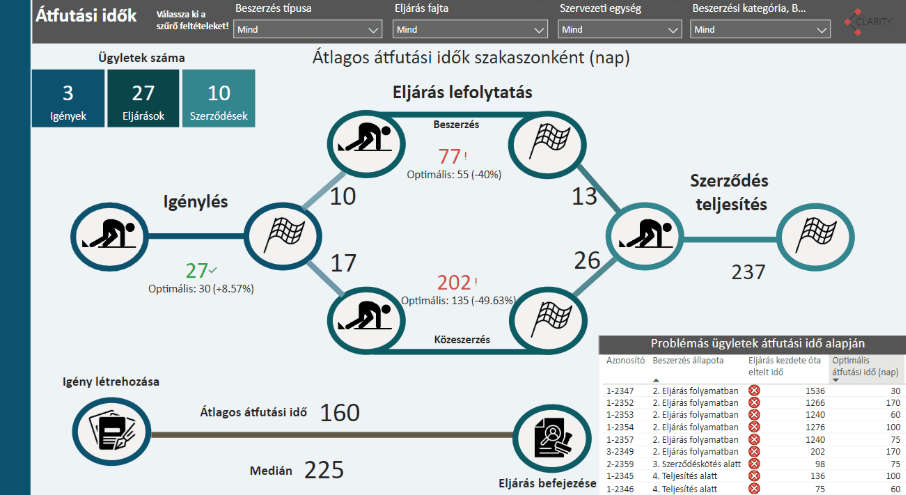
Breaking down lead times into phases allows for the identification of critical points in internal operations, and it is also possible to review problematic transactions.
Financial Predictability
In connection with procurement, various financial aspects also play an important role, among which budget predictability stands out the most. The budget dictates the available funds, which must obviously be taken into account during procurement. Where management is carried out along budget lines, procurements (and their elements, such as procurement plan lines, requests, procedures, contracts, purchase orders, invoices, etc.) must be linked to a budget line so that the financial reservation of budget lines can be tracked. The Budget Monitoring dashboard serves this purpose:

The dashboard can display the total budget amount, the reserved portion of it, and budget utilization. By drilling down into the data, the specific procurements linked to that budget line can also be listed. (The tool will soon be expanded with a budget planning component, but in its absence, the report can also be displayed by loading an external data source.)
Summary
Modern organizational management requires data-driven decisions, which means that without up-to-date information, well-founded decisions cannot be made. In our experience, generating information becomes increasingly difficult even without an increase in organizational size, because the volume of information continuously grows simply with the passage of time. If data extraction is largely manual, information will inevitably be inaccurate, and the larger the volume of data to be managed, the greater the risk of distortion. Excel spreadsheets only provide temporary solutions and at some point become confusing and/or unmanageable. True data management begins with the automation provided by modern information systems.