1. Introduction
Procurement is a key factor in the operation of any organization, as it directly affects cost-effectiveness, optimal resource allocation, and financial stability. Many perspectives clash during procurement: value for money, time spent, corporate strategic goals, environmental protection, energy efficiency, supporting SMEs and local businesses, etc. In the public sector, public procurement processes are regulated by strict legal requirements, which is why transparency and regulatory compliance are also essential in this area. While satisfying all these perspectives and expectations, procurement must also be fast, efficient, and smooth, which poses a significant challenge to procurement professionals.
Digitalization and Artificial Intelligence (AI) are playing an increasing role in optimizing procurement processes, similar to other areas of life. AI-based systems are capable of automating repetitive tasks, analyzing real-time data, and reducing the potential for human error, thereby increasing efficiency. Intelligent algorithms contribute to supplier selection, data-driven decision-making, and reducing administrative burdens.
This article explores how, based on international experience, artificial intelligence is transforming procurement processes and what competitive advantages it can provide for organizations. It also demonstrates how it can support the work of procurement professionals.
2. AI in Procurement Processes
Artificial intelligence is revolutionizing business operations through automation, predictive analytics, and intelligent decision-making. It is capable of processing vast amounts of data and identifying patterns, thereby supporting strategic planning and increasing operational efficiency. In many areas of companies – from customer relations to finance and procurement – AI contributes to cost reduction and competitiveness improvement. With the continuous development of technology, AI is becoming increasingly integrated into everyday business processes, creating new opportunities in the field of digitalization.
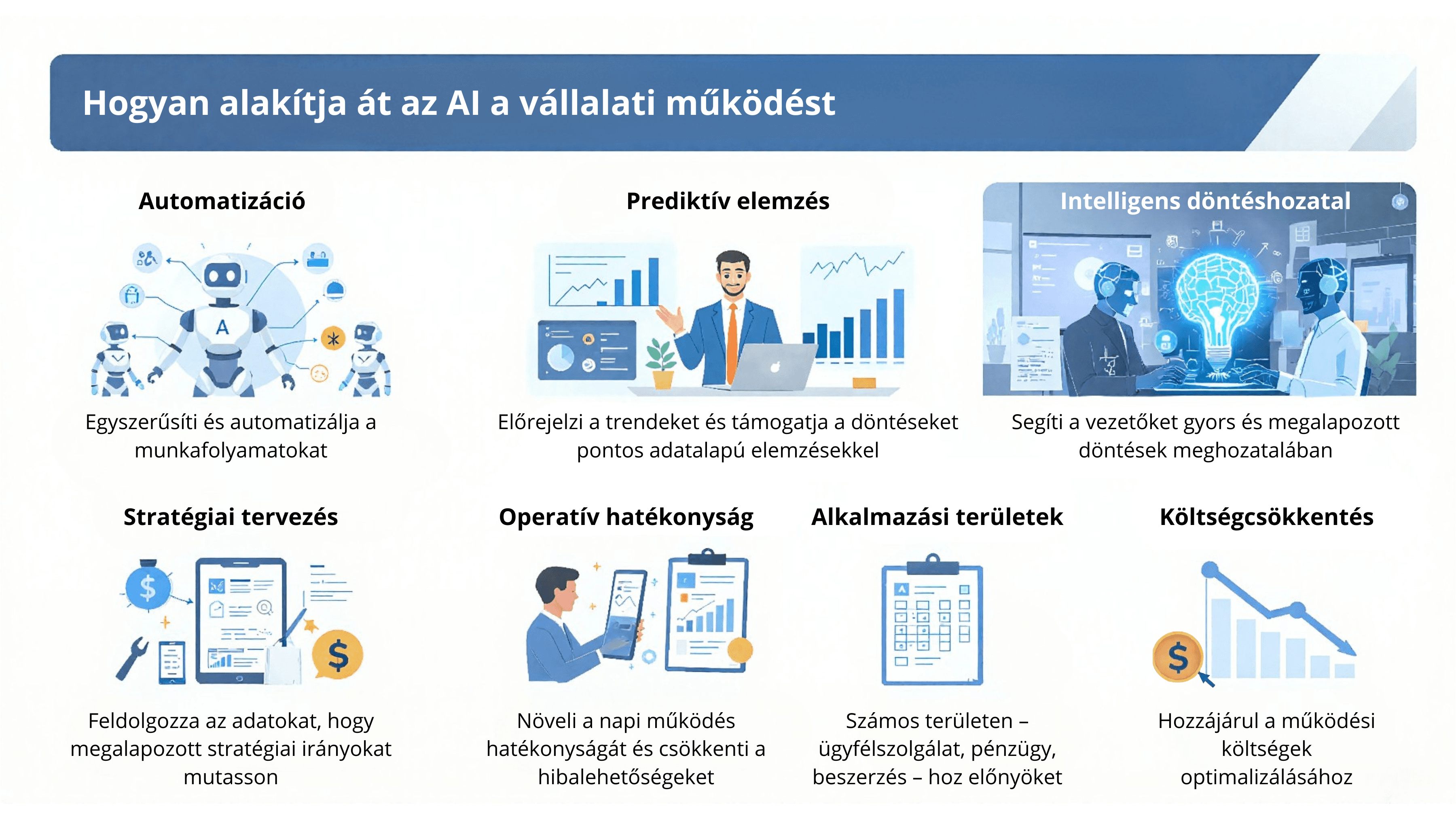
Procurement systems are also increasingly relying on AI, as procurement is no exception when it comes to consisting of a series of human activities. AI - as we know it today - is equally capable of acting as an assistant to support procurement professionals in data analysis, decision-making, and performing repetitive, "mechanical" tasks, just like in other professional fields, thereby helping to utilize human resources more effectively. Moreover, due to its learning capabilities, the potential at this level goes far beyond, and the limits of AI cannot even be predicted today. AI – based on information available on various professional websites – can assist procurement processes in several ways; here are some interesting ones:
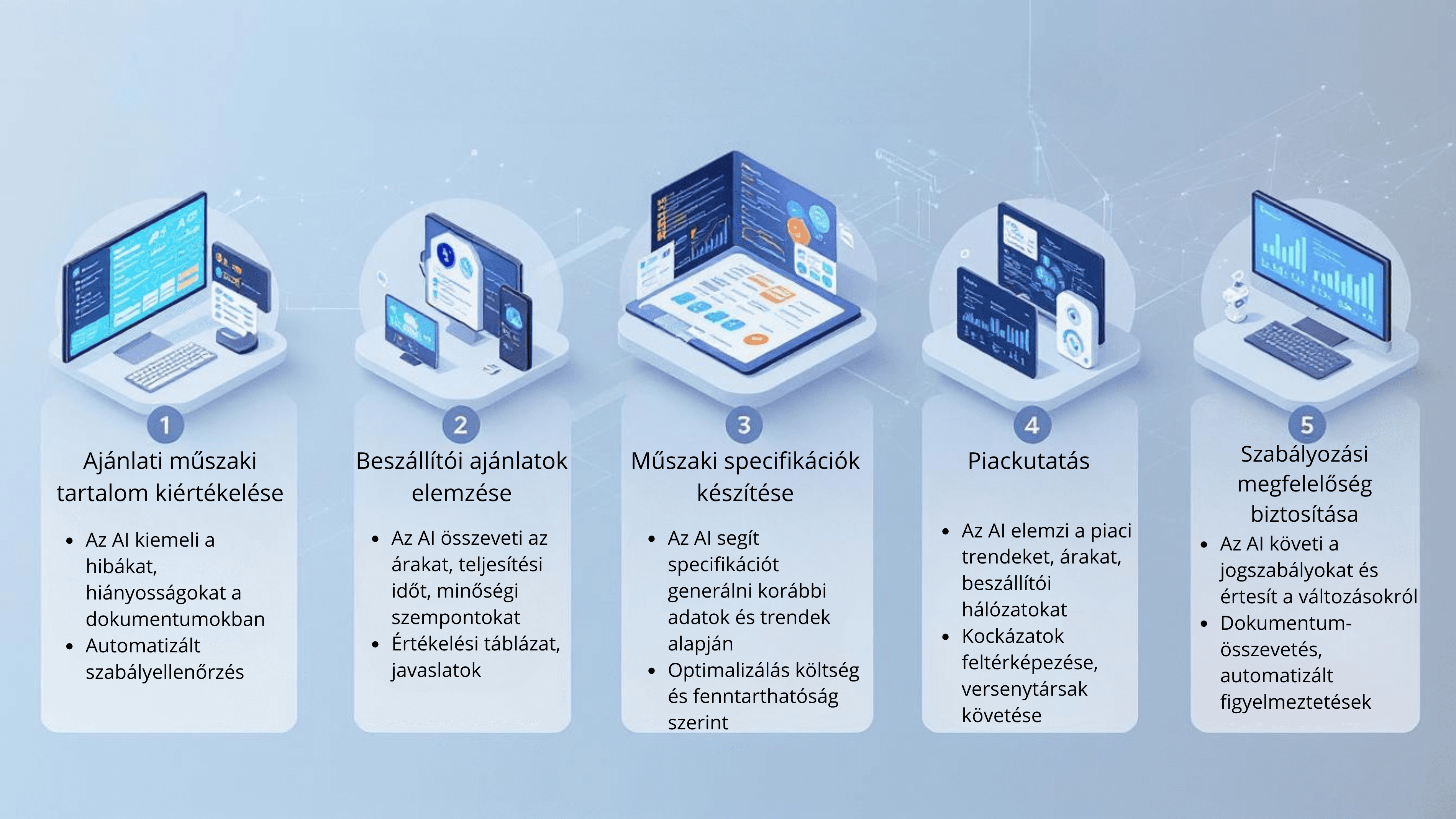
Evaluation of Technical Content in Tenders – By processing structured and unstructured data, it enables faster and more accurate evaluation.
Analysis of Supplier Proposals – AI algorithms compare offers based on price and other evaluation criteria (e.g., warranty, delivery time, additional experience of the involved professionals).
Preparation of Technical Specifications – It helps in defining and optimizing technical requirements, gathering and comparing technically equivalent products, and determining estimated prices.
Ensuring Regulatory Compliance – It ensures the compliance of procurement processes with legal regulations through automated checks.
Market Research – It provides fast and efficient analysis of market trends, supplier networks, competitors, and available prices.
These will be discussed in slightly more detail below.
2.1. Evaluation of Technical Content in Tenders
In (public) procurement procedures, the evaluation of technical tender documentation plays a crucial role in comparing proposals and selecting the appropriate tenderer. AI-based systems offer a significant advantage in this area, as they can automate data processing, making the evaluation process faster and more accurate. Following appropriate preprocessing, intelligent algorithms can analyze both structured and unstructured data, thereby helping decision-makers filter relevant information and identify potential errors, deficiencies, or discrepancies.
Artificial intelligence also supports checking the regulatory compliance of technical documentation, thereby reducing the potential for human error. Automated systems can pre-screen proposals to ensure they meet the prescribed requirements, allowing experts to manage their time more efficiently. Furthermore, AI can contribute to the objectivity and transparency of the evaluation (provided that the algorithms are based on transparent logic and unbiased data), as it is capable of comparing offers against a uniform set of criteria, thereby reducing discrepancies arising from subjective judgment.
2.2. Analysis of Supplier Proposals
AI algorithms allow offers to be compared objectively and quickly based on their key factors, such as price, quality, and delivery time.
Price: AI can analyze offer prices in detail, taking into account discounts, shipping costs, and long-term maintenance costs, thus helping to find the optimal value for money.
Quality: In quality evaluation, AI systems analyze customer reviews, tests, and expert opinions. This enables the selection of the highest quality products or services, while sustainability and reliability are also key considerations.
Delivery Time: AI is capable of predicting delivery times by considering the fulfillment history of suppliers. This helps in selecting fast and reliable suppliers, reducing the risk of supplier delays.
2.3. Preparation of Technical Specifications
Precise technical specifications are crucial for procurement decisions, as they ensure that the products or services offered by suppliers meet the company's needs.
Defining Technical Requirements: AI systems can analyze the company's historical procurement data and industry standards to help establish precise technical requirements. AI can process technical descriptions and generate recommendations for the most suitable requirements, taking into account the specific needs of the given product or service.
Optimization: In optimizing technical requirements, AI can consider multiple variables, such as costs, deadlines, and sustainability. Machine learning algorithms analyze the advantages and disadvantages of different solutions (specifically: models can recognize patterns and correlations between the outcomes and characteristics of solutions), which ensures achieving optimal technical parameters and the best cost/performance ratio. AI can help shape optimal specifications by also considering corporate goals and market trends.
2.4. Ensuring Regulatory Compliance
Procurement regulations change frequently, especially in the areas of public procurement and tax regulations. AI can help integrate these changes into the company's procurement processes in real-time:
AI-based systems can automatically monitor and analyze regulatory changes from official government and industry sources.
AI provides assistance in comparing internal company policies and contracts with current legal regulations, bringing potential discrepancies to light.
The system sends notifications to procurement managers if a new regulation requires a modification in procurement practices.
2.5. Market Research
Artificial intelligence in procurement market research allows companies to analyze market trends, supplier networks, and competitors quickly and efficiently. AI-based systems continuously collect and analyze industry data, providing procurement specialists with up-to-date information on raw material prices and demand and supply trends. Automated analysis reduces manual labor requirements and provides more accurate forecasts of expected price changes, supporting strategic procurement decisions.
In the analysis of supplier networks, AI can evaluate the reliability, financial stability, and past performance of potential partners, thereby minimizing risks. The systems can identify weak points in the supply chain, predict supplier issues, and offer alternative solutions. Additionally, through the continuous monitoring of competitors, AI helps companies optimize pricing strategies and respond quickly to market changes.
3. Challenges and Future Opportunities
The application of artificial intelligence in procurement offers numerous advantages, but it is not without challenges. One of the biggest obstacles is the technological maturity of companies and the cost of AI integration. Implementing more advanced algorithms requires significant investment and expertise, which can be particularly challenging for smaller companies. Additionally, the quality and availability of data play a crucial role. If the data is inaccurate or incomplete, AI-based systems cannot perform analyses correctly, which can distort procurement decisions and forecasts.
The issue of trust can also pose a serious challenge. Although AI is fast and efficient, many procurement decision-makers still treat AI-generated recommendations with reservations. Accepting automated decision-making requires time and education, as many still trust traditional, human decision-making processes.
However, among future opportunities, there are plenty of promising directions. The advancement of machine learning allows AI to provide increasingly accurate and intelligent recommendations, and decision-making processes can be built even more on data-driven foundations. As companies increasingly adapt to data-driven operations, AI can become more deeply integrated into procurement strategies, promoting cost reduction, sustainability, and the optimization of supplier relationships.
The development of AI also gives companies the opportunity to be more flexible and proactive in responding to market changes while reducing the potential for human error and costs. As the technology matures, it becomes increasingly clear that artificial intelligence not only enables efficiency but also the transformation of procurement processes, opening up new business models and opportunities for companies.
Clarity is also actively addressing this issue, aiming to develop AI assistants that can, on one hand, effectively support the work of employees involved in procurement processes, and on the other hand, provide services to users by building on our CPS procurement support system. The former includes the creation of AI assistants for defining technical content, establishing estimated value, and comparing offers based on evaluation criteria, while the latter group includes the creation of agents capable of individual data queries, generating analyses, and performing data uploads. According to our plans, we will be able to report on our achieved results in the first or second quarter of 2026.
Sources, articles where interested readers can read about further interesting use cases:
Artificial Intelligence and Public Procurement
(https://ertesitoplusz.kozbeszerzes.hu/documents/420/KEP202310_KI3..pdf)
AI in Business – how it can support procurement departments (https://transpack.hu/2024/02/14/logisztika-mesterseges-intelligencia-csomagolas-logisztika/)
SAP Business AI in Procurement (https://www.sap.com/hungary/products/spend-management/ai-for-procurement.html)
AI in Procurement: Transforming Processes with Artificial Intelligence for Unmatched Efficiency (https://www.getfocalpoint.com/ai-in-procurement-transforming-processes-with-artificial-intelligence-for-unmatched-efficiency/)
3 ways artificial intelligence is transforming long tail procurement (https://www.manutan.hu/blog/3-modszer-amellyel-a-mesterseges-intelligencia-atalakitja-a-long-tail-beszerzeseket/)
Keenan, P. (2020). AI in Procurement: How Artificial Intelligence is Transforming Procurement Processes. Harvard Business Review
Jain, S., & Narayan, B. (2021). AI-Powered Procurement and Supply Chain Optimization. Springer
Sartor, M., & Iacob, M. (2019). AI in Procurement: Optimizing Technical Specifications and Supplier Selection. International Journal of Artificial Intelligence and Expert Systems
Baker, P., & Topham, P. (2020). Artificial Intelligence in Business and Industry. Cambridge University Press.