In recent decades, the rethinking and optimization of organizational processes and, in parallel, the digitization of activities have also taken on a prominent role in the public sector. However, digitization has primarily been able to progress spectacularly in areas where general, standardizable activities had to be supported by IT tools. Not surprisingly, these mainly covered back-office tasks, essentially performed by every organization and well-defined by legislation, such as HR, finance, invoicing, or document management. Performing such activities is now unimaginable without software support, and solutions serving these needs, including specifics arising from public sector operations, are widely available on the market. We note that it is precisely this kind of wide market availability (combined with complex vendor-side domain knowledge related to the given business or professional field) that has facilitated the spread of these ICT solutions.
However, there are also back-office activities where digitization within budgetary organizational frameworks has so far been more difficult and slower to take place. In our view, procurement support also belongs in this category, which is currently characterized by solutions in the public sector that can be considered hybrid: that is, partly paper-based, partly e-mail communication, supported by traditional office applications. Yet, there are already modern IT solutions in this area too, which can reduce the organization's administrative burden and increase efficiency.
The economic crisis and the resulting necessary financial restrictions highlight even more that planning and maintaining budget frameworks is a diverse, complex task for an organization, which cannot be ensured solely through financial controlling methods and tools. Close cooperation between the procurement and financial areas, as well as comprehensive IT support for these activities, is an integral part of corporate operations; it is an interesting question why the public sector in our country is still lagging behind in this area. According to our experience, procurement and economic managers in public administration circles have also increasingly demanded that
procurement (in terms of both activities and spending) be plannable and traceable,
the availability of up-to-date information allow for plan/actual analyses, checking aggregation rules, faster decision-making, and intervention in case of bottlenecks,
besides execution in compliance with external and internal regulations, the organization's (public) procurement processes become faster and statuses trackable,
forms used for requests or other activities are properly filled out and necessary attachments are appended to avoid unnecessary iterations.
Serving these needs with IT tools can, of course, be achieved in several ways. However, the latest international experiences and best practices increasingly show that, wherever possible, instead of custom development, purchasing a ready-made (out-of-the-box) product and customizing it as needed is the most effective approach. (Among the reasons for this, we can mention first of all the budget and predictability aspects described above, and secondly, the significant resource and time requirements generated on the client side in the case of an IT system specified and developed 'from scratch'.)
But let's look at what happens when the ready-made product is written on a low-coding platform* whose technology ensures fast customization. This study is about that.
Definition of low-coding platform: a software development toolset that enables the rapid creation of business applications with minimal coding and minimal configuration, training, and deployment effort.1 These platforms provide a graphical interface for software creation, which can significantly shorten the development process.
International Outlook
In one of its studies, Forrester analyzed how applications created on a so-called prescriptive low-code platform combine the benefits offered by out-of-the-box products and low-code.2 "Low-code tools enable fast delivery, prescriptive low-code even faster." During the Covid period, serving increased IT demands quickly came to the fore. It was then that it became clear that vendors offering products prepared on a low-code basis with ready-made functionalities, application blocks, and schemas could act as serious competitors even to traditional large vendors. Indeed, clients who wished to implement a customized product faced the fact that this requires significant time with traditional software. A different development philosophy lies between the two methods: while the traditional out-of-the-box product prioritizes the solution itself (package-first), the philosophy of prescriptive low-code is to enable building as quickly as possible in the tool while having prepared elements (essentially Lego bricks) available that speed this up even more (development-first).
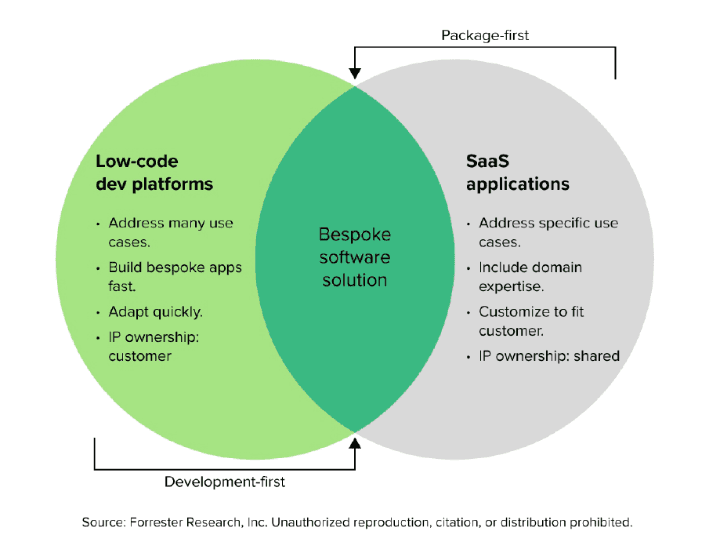
The goal of such tools is therefore to combine the advantages offered by an out-of-the-box product with what a low-code development framework can provide. The greatest value of such software lies in significantly speeding up customization to the customer's unique needs, as well as providing further building opportunities.
What are our domestic experiences, what can Clarity offer in this area?
Clarity Consulting Kft. has focused extensively on IT support for procurement and public procurement, and the electronic enablement of processes, virtually since its foundation (2001). When creating our modularly structured CPS (Clarity Procurement System) software supporting (public) procurement, it was an important consideration to combine all this business-specific domain knowledge into one product and to choose a platform that, besides being capable of providing a comprehensive solution for digitizing procurement processes and activities, also ensures the fast fulfillment of unique needs. We deemed this essential because our experience showed that while there are "standard" solutions resulting from legal regulations or various best practices, significant differences can be observed in how organizations actually carry out their procurement, what tasks they perform to do so, and which actors participate in the process, at what points, and in what roles. Perhaps it is precisely this kind of process management approach that is missing for procurement-supporting software to become more widespread in public administration? We think so.
We designed our procurement system, emphasizing the specifics detailed above, to have "factory-preconfigured" processes, forms, and unified document management related to procedures based on the Public Procurement Act (Kbt.) and best practices, while also providing the option of rapid customization. The software is accompanied by product support tools and methodologies through which implementation can be completed within a very short lead time.
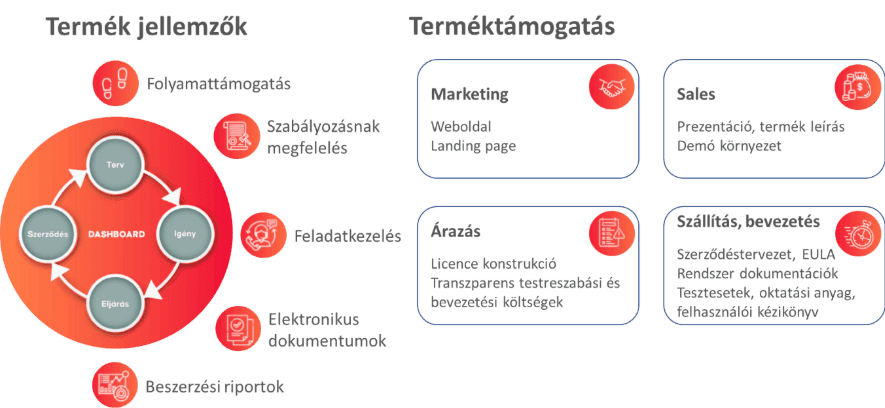
The CPS application comprehensively supports (public) procurement activities in four modules, from planning through request management and procedure execution to contract management. The system is workflow-based and was developed on a low-coding platform in order to implement the rapid customization referred to several times, and where applicable, additional process/task support.
In practice, the tool is usually introduced by implementing the request or contract module, and from there, further building is possible towards other procurement processes (and the modules serving them) if justified in the client's environment.
How does implementation work in practice?
The assessment of requirements can be carried out in a few consultation sessions based on the product's ready-made functionalities and documentation. During this, we can review the pre-prepared processes, forms, and main system logics together with the customer, and jointly define the points where customization needs arise (GAP analysis). The preparation and acceptance of the specification can then be done in a few days; projected onto 1-1 modules, the GAP analysis and specification phase can be completed in 2-3 weeks. The subsequent customization, taking advantage of the platform's capabilities, is also significantly faster than with custom development or in the case of a more complex out-of-the-box product (e.g., an enterprise solution), and can also be achieved in 2-3 weeks.
Overall, therefore, in 4-6 weeks, the customer receives the workflow-based system module customized to their needs for acceptance testing!
For one of our clients, we first introduced CPS for the processes of handling procurement requests and conducting procurement procedures below the public procurement threshold. During implementation, we fully aligned the tool's process management with the organization's internal operations, which can be considered complex in terms of the number of participants and approval points, and the complexity of the forms managed. In the next phase, we integrated request management with the SAP ERP system and extended system support to public procurement and contract management processes. In addition – using the platform's low-coding features and workflow engine – a custom implementation was carried out to support certain financial processes related to procurement. It is important to mention that experience shows software with a strong financial focus typically cannot provide the kind of support to the procurement area that it actually needs. In our view, the best solution is achieved by integrating solutions with different purposes. (This is what happened in this case as well, where with the SAP integration, the client could exploit the benefits provided by SAP while also gaining the kind of process support that CPS is capable of.)
Based on feedback, CPS contributed to solving the following problems of the client:
Before the introduction of the tool, it was common for employees to fill out the various forms used for requests incorrectly or incompletely (or they did not use the correct form for a given request), and achieving operations in line with procurement regulations involved numerous iterations, which obviously led to delays in cases (not to mention workplace conflicts arising from such situations).
Following the implementation of CPS, extra iterations resulting from the incomplete filling of forms ceased, thereby making task execution related to the request process more efficient.
Another recurring problem was that attaching the necessary enclosures was omitted (e.g., support for estimated value, technical content, results of aggregation checks), which led to the same consequences described in the previous point.
Thanks to the validation functions built into the system, the expected attachments can be defined for each process step, so the system does not allow the process to proceed until the necessary enclosure is attached.
If process management is not supported by IT, it is not uncommon for a request or some material of a procurement/public procurement procedure to be sent to the wrong person, or in the case of an approval chain, for stakeholders to receive it in the incorrect order. This can lead to process bottlenecks, slowdowns, and wasted time interpreting regulations, which was eliminated with the introduction of the tool.
In CPS, requests and procedures are built in accordance with external and internal regulations, during which the client's operational specificities can be taken into account. This guarantees the proper execution of processes.
The client had multiple sites, and moving physical documents between them involved significant time and cost expenditures. Shifting case management to electronic channels resulted in significant savings just by eliminating this factor, not to mention the risk of a document getting lost, or having to wait for it to be opened, registered, and forwarded to the right person (who might be on leave) even in urgent cases.
In contrast, a task performed in the CPS system (including attachments) is with the group or colleague who needs to deal with it next in the very next second, thereby speeding up task execution and making it secure.
An organization cannot ignore the kind of frustration felt by employees when they experience that their requests go into a black box: they do not know who is dealing with their request and when, where the process stands, when a decision is expected, or who to contact to get information on the status of their case.
CPS dissolves this black box effect, as its task management functionality makes it trackable where the process stands and who currently has a task. Various automatic notifications and deadline management also facilitate faster workflows, meaning users do not always have to check the system to see if they have a new task and can schedule their tasks based on deadlines.
In many cases, it was a problem for both the procurement and financial areas, and thus for the organization's senior management, that information related to procurement was not transparent, critical bottlenecks occurred, and proper control over procurement was not ensured.
The system provides a solution for reviewing staff workloads, displaying the lead times of requests and procedures or other essential data quickly and visually, identifying bottlenecks, and facilitating aggregation checks, making the procurement path analyzable from procurement plan to contracting – or extended even to performance certification.
If you are interested in the digitization of procurement processes, please visit our website www.beszerzesirendszer.hu, where you can find more information. Learn about our product, request a system demonstration using the demo request on the website, or contact us through our contact details! We are also organizing a webinar for early April, and you can already register your interest on our page.